

Rules
Information
Updated rules and information is in blue font.
Summer League runs up to 14 weeks depending on how many teams are signed up. The only holiday break will be for Independence day if it falls on a Monday, Tuesday, or Wednesday.
Provide each player's name on the score card every week. If a substitute is used, make sure the substitute player's first and last name are written down.
Score sheets and fees need to be placed in the drop box on the night of play. The drop box is located on the wall next to the back office, near the restrooms and Dart machines.
Player Fees
Each player pays a $10 sign up fee on team selection night. Anyone signed up and not selected will get a refund and have the option of leaving their contact number to replace someone who drops out or is removed.
Each 4 person team pays $20 on the week played. The home team is responsible for ensuring the $40 weekly fees are delivered to the league. Any shortage will be taken out of the home team end of season payout.
Match Rescheduling and Forfeits
There has never been a reschedule or forfeit. If a team is not able to play a match, a team of substitutes will be selected to play for them. Players who fail to appear 10 minutes past start time (real time) will be replaced by a substitute unless they inform the league and their team before they are late.
Handicaps
This league will not use handicaps because it is a learning/training league.
Coaching
Players may ask for coaching from anyone in the league. Each team will designate a team coach - this does not need to be the captain. The team coach is able to call one time-out per game to give advise to a player. The time-out may not be used to call a foul.
No coaching will be allowed after 10pm.
Rankings
Teams will be ranked from most wins to least and then by number of team points. Players will be ranked by percent of wins and then by point differential (points you earned minus your opponents points) and then by most points.
Substitutes
Only players in the league are allowed to be substitures. Substitutes should be selected from the ranking sheet and be no more than 8 levels above or below the absent player. Please consider using players from a team that has a bye first.
Captains are only allowed to substitute for other captains.
Score Keeping
See Score Cards for details and bonus information.
The most important thing is to "Have Fun"!
8-Ball Rules
- OBJECT OF THE GAME
Eight Ball is a "Call Pocket" game played with a cue ball and fifteen object balls, numbered 1 through 15. One player must pocket balls numbered below 8 (solids) while the other player must pocket balls numbered above 8 (stripes). The player who pockets their group first and then legally pockets the 8-ball wins the game. - CALL SHOT
Obvious balls, such as straight in, do not have to be called or indicated. It is the opponent's right to ask which ball and pocket the shooting player is intending to shoot if they are unsure of the shot. Banks and combinations are not considered obvious and need to be declared. Care should be taken in calling both the object ball and the intended pocket. When calling a shot, it is NEVER required to indicate details such as number of rails, banks, kisses, caroms, etc. Any balls pocketed on a foul remain pocketed, regardless of whether they belong to the shooter or opponent, except the 8 ball which is a loss of game for the shooter. - RACKING THE BALLS
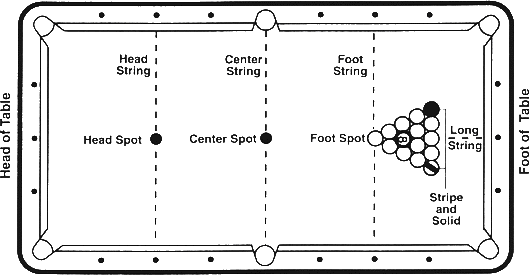
The shooter will rack and break. Object balls need to be racked in a triangle at the foot of the table with the 8 ball in the center, a stripe in one foot corner and a solid in the other foot corner. The head ball must be placed on the spot at the foot of the table.
- LEGAL BREAK SHOT
The breaker, with cue ball fully behind the head string, must drive the cue ball into the racked balls and either a) pocket an object ball or b) drive at least four object balls to the rail. Failure to make a legal break is a foul and the incoming player has the option of accepting the table in position and shooting without ball in hand, or having the balls reracked and either break the rack themselves or allowing the offending player to break again. The table is always open after a break shot, regardless of what drops. - SCRATCH ON THE
BREAK
If a player scratches on a break shot, it is a foul, but not loss of game. All pocketed balls remain pocketed except the 8 ball (see 8-ball pocketed on the break). The incoming player will have cue ball in hand behind the head string and may not shoot an object ball that is behind the head string unless the cue ball travels past the head string first. - OBJECT BALLS JUMPED OFF THE TABLE ON THE
BREAK
If a player jumps an object ball off the table on a break shot it is a foul and the ball which left the table stays off the table. The incoming player has the option of accepting the table in position and shooting, or taking cue ball in hand behind the head string and shooting. - 8-BALL POCKETED ON THE
BREAK
Pocketing the 8-ball on the break is not a win. If the 8 ball is pocketed on the break and the cue ball remains on the table, the breaker may choose to have the 8-ball spotted and continue shooting, or have all balls racked and break again. If the breaker scratches while pocketing the 8, the incoming player will have the option of racking and breaking or having the 8 spotted and begin shooting with cue ball in hand behind the head string. The player may be eligible for a bonus if they are the first to pocket the 8 on the break. See the organizer to report the achievement. - OPEN TABLE
The table is considered "open" until an object ball is pocketed in a legal shot. While the table is open, the shooter is allowed to hit any solid stripe or the 8 ball first in the process of pocketing a called solid or stripe. However, when the 8 ball is the first contact on an open table, the shooter loses their turn and table remains open. Any balls pocketed remain pocketed and the incoming player will play the table as it lies. - LEGAL SHOT (after the break)
The shooter must shoot the cue ball such that it contacts one of their balls first and results in any ball contacting a rail or a pocketing a numbered object ball (other than the 8). Failure to meet these requirements is a foul. If a ball, before or during a shot, is moved on accident by brushing it with the cue stick or by hand, it is not a foul unless the cue ball travel path takes it through where the moved ball was. The shooter will give their opponent the option of restoring the moved ball to its original position or leaving it in place. The shooter may NOT move the ball back unless authorized by their opponent. - THE "SAFETY" SHOT
For tactical reasons a player may choose to pocket an obvious objective ball and discontinue their turn by declaring "safety" in advance. If "safety" is not declared to the opponent prior to the shot, the shooter will be required to shoot again. There is no limit to the number of times a player can call "safety". If both players find themselves at an impasse with calling "safety" on every shot, then the game will be reracked and played over with the original breaker starting again. Both players will split the cost of the game. - THE COMBINATION
SHOT
Combination shots are allowed with the intended object ball and pocket declared. The 8 ball cannot be used as the first contact, but may be used as part of the shot sequence, unless the 8 ball is the legal object ball. The shooter must hit their own object ball first, unless the table is open. - THE JUMP AND MASSE
SHOT
Jump and masse shots are allowed to get the cue ball over or around an opponent's ball, with the intended object ball and pocket declared. The tip of the cue must strike the top half of the cue ball and contact a shooter's object ball first, followed by pocketing a numbered ball or driving any ball to a rail to be legal. It will be considered a foul if, during an attempt to jump, curve, or masse the cue ball over or around the impeding ball (opponent's ball or 8 ball), the impeding ball moves by any means - regardless of whether it was moved by a hand, cue stick follow through, or bridge. - FOUL PENALTY
All fouls must be called before another shot is taken, or else it will be deemed that no foul occurred. When a foul is committed by a shooter, their opponent gets the cue ball in hand. This means that player can place the cue ball anywhere on the table without the head string rule (except if the foul was committed on the break). A player with cue ball in hand may position the cue ball with their hand or any part of their cue stick (including the ferrule). When placing the cue ball in position, any forward stroke motion contacting the cue ball will be a foul, if not a legal shot.
This rule is intended to prevent players from committing intentional fouls which would place their opponent at a disadvantage. - OBJECT BALLS JUMPED OFF THE
TABLE
If an object ball is jumped off the table, it is a foul and loss of turn, unless it is the 8-ball, which is loss of game. All object balls jumped off the table will remain off the table. - SLOW PLAY
In tournament play, each shooter will have 60 seconds to get to the table and 60 seconds to take a shot. While the shooter is at the table they will have 60 seconds for each shot. Shooters taking longer times will initially be warned twice and then, if play is still slow, each shot will be timed for both players by members on both teams. When there is 10 seconds remaining the time keeper will say 10 seconds. If the shooter fails to take a shot before time expires, it will be a ball in hand foul. This rule is generally only used in tournaments unless there are exceptional delays in the matches. In league play, use 120 seconds per shot. - LOSS OF GAME
It is a loss of game:
a) When the shooter fouls while pocketing the 8-ball, except on the break.
b) If the shooter pockets the 8-ball before it becomes the legal object ball.
c) Jumping the 8-ball off the table at any time, except the break.
d) Pocketing the 8-ball in a pocket other than the one designated. - SPORTSMANSHIP
Sportsmanship is simply treating your teammates and opponents with courtesy and respect. While everyone wants to win, the purpose of league play is to have fun playing the great sport of billiards in the company of friends.
17.1 Know the rules: Most disputes can be avoided if both players are knowledgeable about the rules of the game.
17.2 No "Sharking": "Sharking" is any act designed to upset your opponent or disrupt their concentration at any time during the game. Examples are using profanity, making sarcastic comments, refusing to acknowledge an obvious foul, standing close to your opponent’s line of vision or creating sudden noise. These rules apply not only to you, but also to any person who is in your "cheering squad".
17.3 Make sure that the trademark of you and your teammates is good sportsmanship. Win or lose, that’s what league play is all about.
- UNSPORTSMANLIKE
CONDUCT
Unsportsmanlike conduct is any intentional behavior that brings disrepute to the sport or which disrupts or changes the game to the extent that it cannot be played fairly. It includes
(a) Distracting the opponent;
(b) Changing the position of the balls in play other than by a shot;
(c) Playing a shot by intentionally miscuing;
(d) Continuing to play after a foul has been called or play has been suspended;
(e) Practicing during a match (includes shooting on another table);
(f) Marking the table;
(g) Delay of the game; and
(h) Using equipment inappropriately.
Unsportsmanlike conduct can result in a player or team being kicked out of the league. This is at the discretion of the league operators.
 Print
Print 